
WINDTRE puts behavioural economics to work in every customer journey
Behavioural economics is a cutting-edge field of study that is finding widespread application across a broad range of industries that have one thing in common: decision-making by customers. In other words, all industries.
Known for their presence at the forefront of strategy and innovation, it’s no surprise that 3 companies are also using behavioural economics to optimise customer retail experience online, in person, in the workplace and on the phone. Italy’s WINDTRE applies behavioural economics as a guiding principle of its user experience design to enhance the customer’s journey every step of the way.
As a relatively new field, even many experienced business people haven’t come across the concept of behavioural economics.
This field of study examines how people actually behave when making economic decisions, rather than assuming they behave like a theoretically perfect rational actor. The “father of economics”, Adam Smith, advanced a theory in his groundbreaking book, The Wealth of Nations (first published in 1776) that the “invisible hand”, arising from people acting rationally, would produce widespread economic benefits. Taken to an extreme, later economic theory took this to mean that people made economic decisions in a precisely rational fashion, like perfect computers. But economists such as Nobel prize-winner Daniel Kahneman tested this assumption with real people and found it to be false. He found that people made economic decisions informed by a wide range of “irrational” psychological processes including cognitive biases and heuristics.
Cognitive biases are a set of ingrained beliefs and behaviours that influence decision-making. Heuristics refers to the system of mental shortcuts that we make to come to quick conclusions. The “Buy now before it’s too late!” call-to-action (CTA)is an example of using a “scarcity heuristic” – creating the perception of scarcity of a product.
In the early days of online retail design, designers would just present what they thought looked nice. They would essentially guess at what customers might – or might not – like, and what might – or might not – help them with their decision-making.
But WINDTRE doesn’t guess how people act online: they test. Their research focuses on identifying user focus areas through mouse tracking or mobile taps to create heatmaps of activity. This allows the placement of interface elements to be optimised for clarity and effectiveness.
This is all measuring something called user experience (UX). The testing protocols are based on ideas from behavioural economics, and those ideas play a vital role in WINDTRE’s graphic design processes. Principles from behavioural economics guide how WINDTRE designers present choices and design visuals to make it easier for customers to navigate digital platforms, find the information they need and then make a purchase.
Careful testing decides the best spots to place CTAs – those buttons or links that ask customers to take action, such as picking a plan or confirming a special offer. Using simple designs, clear paths for getting around the site and neatly arranged information helps ensure that customers don’t feel bombarded with too much information all at once. This way, using the site or app is straightforward and feels enjoyable.
CTA labels are normally chosen based on multivariate testing that compares many different options with tiny differences between them to select the wording with the highest probability of engaging customers.
As an example, WINDTRE tested a CTA using multivariate A/B testing. The following chart shows the result of testing on the smartphone product detail page on the consumer site:
| Text Variant CTA | Final click rate | |
|---|---|---|
| “Book” | 10.89% | |
| “Continue” | 19.66% |  |
| “Request” | 13.50% |
The choice of “Continue” was the clear winner. At the time, A/B testing was conducted using a product from software giant Oracle, the “Maxymiser”. Today, WINDTRE uses Adobe Target for A/B testing and personalisation.
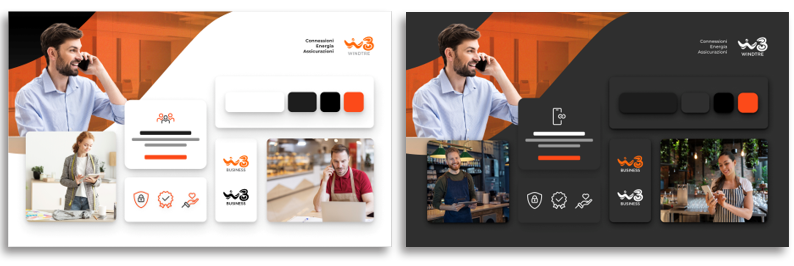
More user research informs retail strategies. For example, WINDTRE conducted perception tests, usability assessments and sentiment surveys with 40 business clients to decide between light or dark modes for its business website. Insights from these studies are important to ensure that design choices align with customer preferences and brand consistency.
WINDTRE also uses “scarcity heuristics” to promote exclusive offers, creating a sense of urgency that ultimately incentivises purchases. A countdown clock showing the expiry of a deal motivates people to act, driving home the fact that the deal will disappear and heightening the sense that something is being lost through inaction. A milder version of this is promoting sale or contest expiration dates in content marketing. Customers who can be slow to act experience frustration if they miss out on deals, leading to complaints. Prompting them to take immediate action can lead to greater satisfaction and a higher sense of value in the product post-purchase.

In the old days of advertising and UX, there was more art than science in the process as people working in these areas would “feel” and assume. Now, WINDTRE carefully tests the actual behaviour of their customers to consider their real decision-making process to help them arrive at the best outcomes for them. Lower stress in choosing products and a better daily online and mobile experience works for everyone, putting behavioural economics at the service of happier customers.