
The Big Data approach driving AS Watson’s retail success
With major shopping holidays like Christmas in the rearview mirror, consumers have been reminded that shopping is a very popular activity. But what consumers may not realise is that behind the many winter holiday promotions are teams of researchers who work harder than Santa’s elves to connect buyers to the goods they seek.
While old-school marketing involved creative guesswork, the modern age of digital technology means that entire marketing and UX/UI (user experience and user interface) design strategies are now developed by testing (and learning from) Big Data. Big Data is a term used to describe very large amounts of data that can reveal trends, patterns and other insights – particularly in human behaviour – that drive important decision-making.
AS Watson collects data from over 6 billion of its shoppers each year. This data is incredibly valuable. Through a meticulous test-and-learn approach, new insights help internal decision makers improve AS Watson’s O+O (Offline plus Online) shopping experience and product sales.
Once customer data has been acquired (e.g. time on page, click-through rate and conversion rate), careful testing gets to the nitty gritty of what matters, sifting through and running hundreds – if not thousands – of tests to draw key insights on how to further optimise features such as site and ad design. A/B tests are a popular example of testing different variables to drive tangible results.
“We use generative AI for more than just A/B testing,” says Dan Jarvis, Chief Digital Officer Europe at AS Watson.
“It’s an ABCDEFG kind of thing. You can take a webpage and tell it to look for up to 15 different areas and variables, and that will create hundreds of little test pages. It runs through those different options and tells us which one the winner is.”
Marionnaud, a chain of perfumeries and makeup retail outlets in Europe, was able to use A/B testing to improve its site search results for men’s fragrance. By redirecting the search for “parfum homme” to the category page instead of search results, they were able to drive a 124% increase in revenue per visit and a 65% rise in conversions.

It’s not always about A/B testing for AS Watson – according to Mr Jarvis, competitor analysis is required to decide what to test next. Heuristics also play an important part in O+O development.
Heuristics are the ingrained assumptions and thought processes we use to quickly assess new information. Heuristics are often described as “rule of thumb” thinking and form part of the burgeoning field of study called behavioural economics. AS Watson takes these customer instincts into consideration when optimising designs. Customer habits and behaviours are always front of mind – and it’s often the small and subtle changes that can lead to big results.
What may seem like a minute difference to the average person is considered a win in AS Watson’s test-and-learn approach.
“UX is about making tiny little tweaks to get incremental gain,” Mr Jarvis explains. He adds that employing these “little tweaks” can have a huge impact and lead to significant boosts in sales and marketing KPIs (key performance indicators).
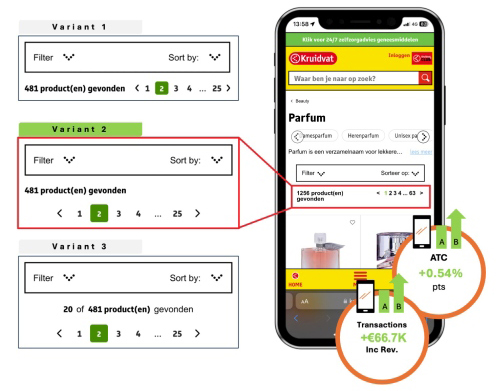
For example, Kruidvat, AS Watsons’ Dutch health and beauty retail chain, found incremental success by optimising the mobile site’s pagination section. Heatmapping data showed that less than 5% of online users were interacting with the feature that allows users to navigate from page to page, which was affecting conversion rates. Kruidvat was able to test three different variants of the pagination section against the original, deciding on Variant 2 as the winner. On paper, the numbers may not seem like much; Variant 2 won, with an increase in “add to cart” and “conversion rates” (+0.54% and +0.01% respectively). That said, this new pagination section led to an impressive €66,749.66 boost in incremental revenue compared to a base group over a short test phase.
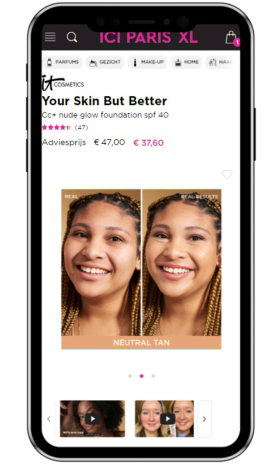
Kruidvat also improved its product details page by adding visuals to show product application (how customers actually use products) and sizes. Tests showed that conversion rates increased by over 3% on both mobile and desktop, proving an incremental and significant success.
As the world of O+O shopping evolves at a rapid pace, the application of the higher-level thinking behind behavioural economics and practical data-driven design will continue to revolutionise how customers shop – minimising time-wasting and maximising convenience. By leveraging cutting-edge technology, AS Watson ensures that shoppers can find what they need faster and check out with less hassle. Every tweak – whether in site navigation, search functionality or page layout – works towards creating a seamless shopping environment that fits effortlessly into our lives.